

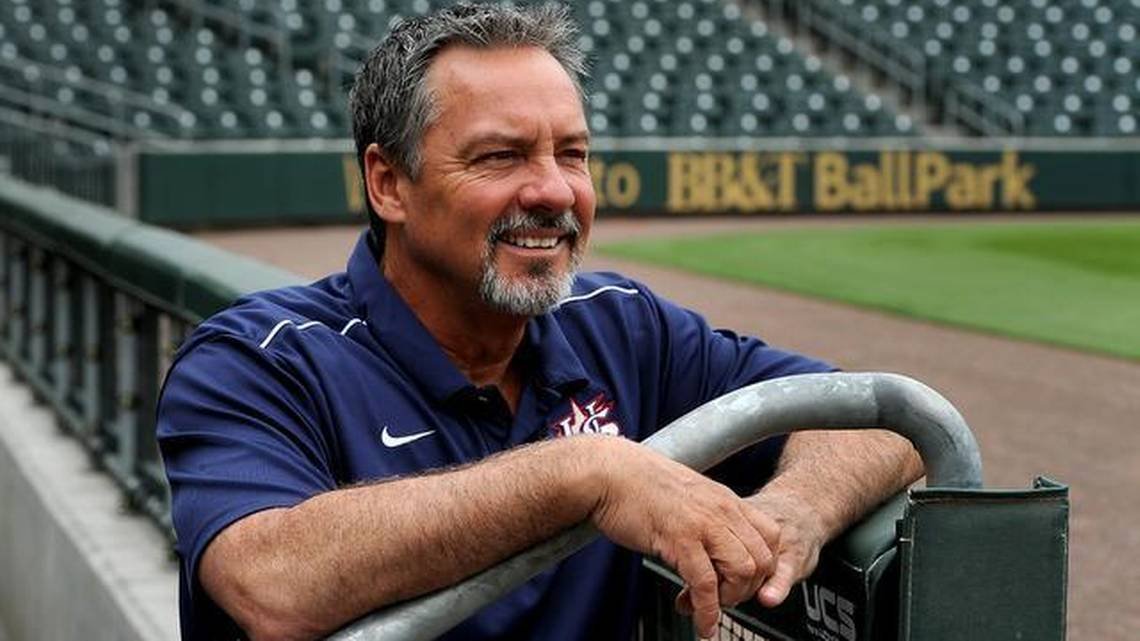
(Photo Credit: Jeff Siner/ Charlotte Observer)
Knowing a strike was looming, Jeff Schaefer walked into manager Tony LaRussa’s office in 1994.
“I need you to send me to the minors,” said Schaefer.
“What do you mean?” LaRussa replied.
“Well, I have a nice minor league split on my contract.”
“Okay, Iet me see what I can do,” said LaRossa.
Shortly after, Schaefer was granted his request to be sent to Triple-A Tacoma, which would not be shut down despite the strike at the Major League Level.
“I’m forever grateful to Tony LaRussa for that,” said Schaefer.
Schaefer went to Triple-A assuming that the strike would be resolved in short order. But that was not the case – in fact it leaked into Spring Training and at 34-years-old with a wife and two daughters, he decided that it was time to hang it up.
Schaefer played parts of five seasons in a big league uniform, despite overcoming many inherent obstacles to doing so. Let’s turn back the clock and discuss.

The Early Years
Jeff Schaefer was born and raised in Patchogue, NY. He was a sports junkie, noting that he loved baseball but he really thought his future would be on the ice rink.
Unfortunately due to financial reasons, he stated that hockey was tough to pursue due to the early ice times and costly equipment.
Schaefer played baseball with his friends on the street, but make no mistake – he was under no assumptions that he was going to make it to the big leagues. In fact, it was not even a thought in his mind.
“The guys in Major League Baseball, it seemed like a fantasy. Nobody thought they would come out of Patchogue and go to the Yankees and Mets. The big players were in Arizona, California and Texas. That’s where all the baseball players came from.”
In the pre-internet days, there was no Perfect Game to keep tabs on who the top players in your area were. As luck would have it, though, he played on the Port Jeff A’s with Neal Heaton, who would go on to become the first overall pick in the country out of Sachem HS and played 12 seasons in the big leagues.


Schaefer noted that they went out to New Mexico to play in, and ultimately won, the Connie Mack World Series in 1978.
“Neal was getting ready to go to Miami and I had no idea where I was going. I came home and my dad told me, ‘You’re going to Maryland.’ I said, ‘Great, where’s that?”
His father, Phil Rogers, was an All-ACC catcher in his playing days. His coach, the legendary Elton Jackson, was still at the helm. His tenure spanned from 1961-1990 and won two ACC Championships.
His father told Jackson, “He can throw, he can field, he can run, but you’ll knock the bat out of his hands.”
Schaefer stated that not only was he small for the ACC (5’8, 145 lbs), he had “no idea how anything worked with getting drafted.” He said, “Guys used to talk about getting drafted and I thought, to the military?”
Growing up on Long Island, he noted that he could probably count on one hand how many times he left the area. He stated that “I basically lived in a bubble. We went to the Bronx. We went to a tournament in Allentown, PA and flew to New Mexico. That was it.”

Maryland
As time went on, he grew accustomed to playing high-level college baseball. Schaefer stated prior to playing college ball, he assumed he would either join the military or work for the Town of Brookhaven after high school.
“We played Clemson, NC State, North Carolina, etc. I wasn’t afraid. I just thought, give me some spikes and a glove and I’ll play – a real Long Island mentality.”
A turning point for him was once he started seeing guys get drafted and make money.
“At that point, I had definitely fallen in love with the game and knew I had something different than the majority of the guys we played against.”
Schaefer had translated that love to success on the field. He was named Honorable Mention All-American and was first team All-ACC.
Maryland was unable to capture an ACC Championship during his time, despite winning the regular season title and leading the country in homers one of the years.
Schaefer has fond memories of playing at Maryland, facing some notable players such as Jimmy Key, Tim Teufel and Mike Brown.
In 1981, Schaefer was selected by the Baltimore Orioles in the 12th round of the MLB Draft. In those days, before the MLB Network and social media, there was only one way to find out if you had your dreams fulfilled.
“I sat by the phone all weekend and hoped it rang,” Schaefer said. I heard a lot of, ‘You’ll go in the first three rounds.’ Well, that didn’t happen. The next day, the phone rang, in the 12th round. I was somewhat disappointed. But then I said, alright man, throw me in the mix. Give me a shot and I’ll climb through everyone.”

Pro Ball
While everyone would love to believe it’s a quick path to the majors – often times it is not. It took Schaefer several years of scratching and clawing to break through and eventually get the call to The Show.
Schaefer was assigned to Bluefield, WVU.
“In terms of facilities, it was a step down from the ACC. And we used to laugh, the prettiest girl in town had one tooth,” he said jokingly.
Despite that, it did not put a damper on his enjoyment.
“It was a long climb, but on the other side of that, it was never a grind. I was a kid, I didn’t even know where I was at. I was given a uniform and was going to play baseball. I went further than a lot of people ever dreamed of.”
From 1981 to 1988, Schaefer kept his head down and took the field He eventually became a minor league free agent and signed with the Seattle Mariners.
“Yeah I felt I deserved an opportunity sooner, but there’s higher draft picks, or whatever it was. I had to get past the disappointment quickly.”
Schaefer experienced plenty of winning in the minor leagues – his teams won 4 championships over the years. He experienced plenty of personal success too, including batting .304 and being named to the Texas League All-Star team in 1987.
He was performing well and he was in his physical prime. It was time to get called up to the big leagues. Or so he thought.
He got called into the manager’s office one afternoon and he was preparing himself to get the good news. Instead he was hit with the opposite.
“I was aggressive – in my personality and my actions. They told me that Tommy LaSorda doesn’t want to manage you. I was absolutely heartbroken.”
The next year he was in Triple-A with the Chicago White Sox minor league affiliate playing for Vancouver. Once again, he was right on the cusp of the big leagues.
“It was customary in those days that if you were getting called up to the big leagues, they would take you out of the lineup. It was a double header, they knew, I didn’t know that I was getting called up. I dove for a ball and dislocated my shoulder. I went back to the clubhouse and saw one of the guys from the big leagues and asked him what he was doing there. He said he got sent down and I was going up. They ended up sending him right back up.”
Just a cruel twist of fate, but Schaefer would not be denied. After the season, he had to make a decision.
“I basically told the White Sox that I’m done. I have a wife, a kid and another on the way. They told me, if you come to camp, you have a good chance to make the team. I told them, if I don’t make the team I’m going home. I did make the team.”
He wound up playing in 15 games for the White Sox, getting the opportunity to play with future Hall of Famers Carlton Fisk and Harold Baines.
After the season, he chose to sign with the Seattle Mariners as a utility infielder.
Those were some star studded teams for the Mariners. Schaefer had the opportunity to play with Ken Griffey Jr, Edgar Martinez and Randy Johnson.
“There were some good people that played the game. It wasn’t about how many likes you got. We were baseball players, not entertainers,” he added.
Schaefer noted that he keeps in contact with many of his former teammates, especially Brian Holman, whose claim to fame was being apart of the Randy Johnson-to-Seattle trade in 1989. The following year, he nearly etched his name in the record books as he was one out away from a Perfect Game before Ken Phelps hit a solo HR to break it up. Schaefer noted he keeps in touch with him almost daily as they discuss politics.
The Strike of 1994
There was always a business side to the game of baseball. Despite the fact that salaries of exploded since the 1990s, it’s all relative.
Schaefer noted “back then, it was a big deal to make $150,000 a year. You had Kirby Puckett at $3 million. We knew the strike was coming, so I walked into LaRussa’s office and said I need you to send me down. He said ‘what do you mean?’ so I told him I have a nice minor league split on my contract and the minor leagues weren’t going to shut down. He said ‘let me see what I can do’. They sent me to Tacoma, and I’m thankful for that. That was it, I went home thinking this will be done in no time. It went into Spring Training, I was a free agent. They asked if I wanted to be a scab, I said no chance. I had friends that did that, it didn’t change my friendship with them but I was in the player’s union and I wouldn’t do that.”
Eventually Major League Baseball did resume, but it wasn’t until April 25 – with the season being shortened to 144 games. Schaefer noted that he had some opportunities to continue the game, but he opted to move on.
“I wasn’t working out the way that I should, I didn’t know if I had it in me at 34-years-old. I got a couple offers, I also got a couple offers to stay in the game and coach. I had 2 kids at that point.”
With that, Schaefer closed the book on his big league career.
The Next Chapter
Schaefer is still heavily involved in the game of baseball. For starters, his youngest son is a shortstop at UNC-Wilmington. At the time of this interview, he was driving down to ECU to catch his next game.
He is the Northeast Regional Director for USA Baseball. He is in charge of overseeing over a dozen states along with his staff that identifies the top youth players in the region to compete on the national stage.
Additionally, he is the owner of a baseball academy called Pro Stock Royals Baseball Training Academy in Charlotte, NC.
On their website, it is described as the “Premier destination for competitive high school and post-graduate baseball athletes.”
He noted that they were able to raise $10 million to build the facility. They play a full a schedule. They just recently turfed one of the fields through a grant by Major League Baseball and they will be turfing their other field.
Schaefer, along with Todd Friedman and Chris McKnight formed Advocacy Baseball Consultants a little over a year ago. The company has already placed over 40 players into college.
Friedman was a Division-I player at Winthrop University and McKnight has coached at a number of schools including locally at SUNY Old Westbury and Dowling College.
In regards to Advocacy Baseball, Schaefer said:
“So much has changed in college baseball. The rosters are getting ready to be condensed. The draft going to 20 rounds instead of 50, when I played. The opportunities have become more difficult to come by. If they go down to 34 players, over 1800 players will be in the portal. Not everyone is going to get a chance. It can be a black hole. If you don’t have someone advocating for you with a pedigree like we have. When I call and talk to coaches, these guys know what a Division-I, Division-II or Division-III player looks like. Our word carries enough that they’ll go out and look for this guy.”
Schaefer is a baseball lifer and has committed himself to helping advance the careers for younger athletes. In this era of college baseball, it’s getting harder and harder for local players to stand out, and people like him – that played the game at the highest level while staying involved in youth baseball – are needed in this environment.