

by Trevor Dugan
Baseball players have been using the laws of physics to their advantage since the sports inception in the 19th century. From the invention of the curveball to the modern obsession over launch angles, physics and baseball have always been deeply intertwined.
The same is true for every sport, and biomechanics is at the root of it all. Biomechanics, as it relates to sports, is the study of the response of the body to mechanical force, with the goal of understanding the most efficient way to move to get the most out of your movements and avoid injuries. Many athletes who were unfamiliar with this term have likely already been exposed to its principles in some capacity by coaches while learning to throw a ball or swing a bat or stick.
While it may not be at the forefront of the average youth athletes mind, understanding biomechanics from a young age allows athletes to perform better and stay healthy throughout their athletic career. Thats why Madeline Podaras and Shaun Manning began their training program Biomechanics in Motion.
Madeline Podaras graduated from Columbia University with a Masters in biomedical engineering, specializing in sports biomechanics. She grew up as a three sport athlete, with lacrosse as her main focus, and is also a certified personal trainer.
Shaun Manning is the head coach of Long Island Lutheran Varsity Baseball as well as the general manager of Complete Player Development in Carle Place, where the training program is hosted.
The stated goals of Biomechanics in Motion are the implementation of proper biomechanics, injury prevention, and the development of athleticism and performance. Manning explained the thought process behind the decision he and Madeline made to begin offering this training program.
We started Biomechanics about two years ago, and the reason behind it is that in recent years sports science has become very prevalent in player development, Manning explained. Using that science, our goal is to develop kids to be better athletes while not limiting ourselves to just baseball. A kid who’s a baseball player today might be a football player down the line.
It is important that athletes learn the right way to move from a young age, while it is easier to turn specific movements into muscle memory. Madeline Poadras explained this concept further, and detailed the age range that Biomechanics in Motion hopes to target.
From the ground, all the way up to their arms where theyre swinging or throwing, there are specific patterns we want to train, Podaras said. Making that connection with their brain and body is what we want to do at this stage, so that when theyre older that’s just second nature. We think our sweet spot where we can do the most to help is that 10-12 range. Why we chose that age range has a lot to do with neuroplasticity, the prepubescent age is the best time for us to create strong foundations and new neural pathways they can take with them.
The key to the program is kinematic sequencing, something Madeline has studied extensively in motion capture labs and other research environments throughout her career. Kinematic sequencing is the order in which body segments accelerate and then decelerate during a powerful athletic movement to maximize speed or power and minimize injury. Through each step of the program, Podaras goal is to get athletes to focus on how and why they are moving, so they can get used to moving as efficiently as possible.
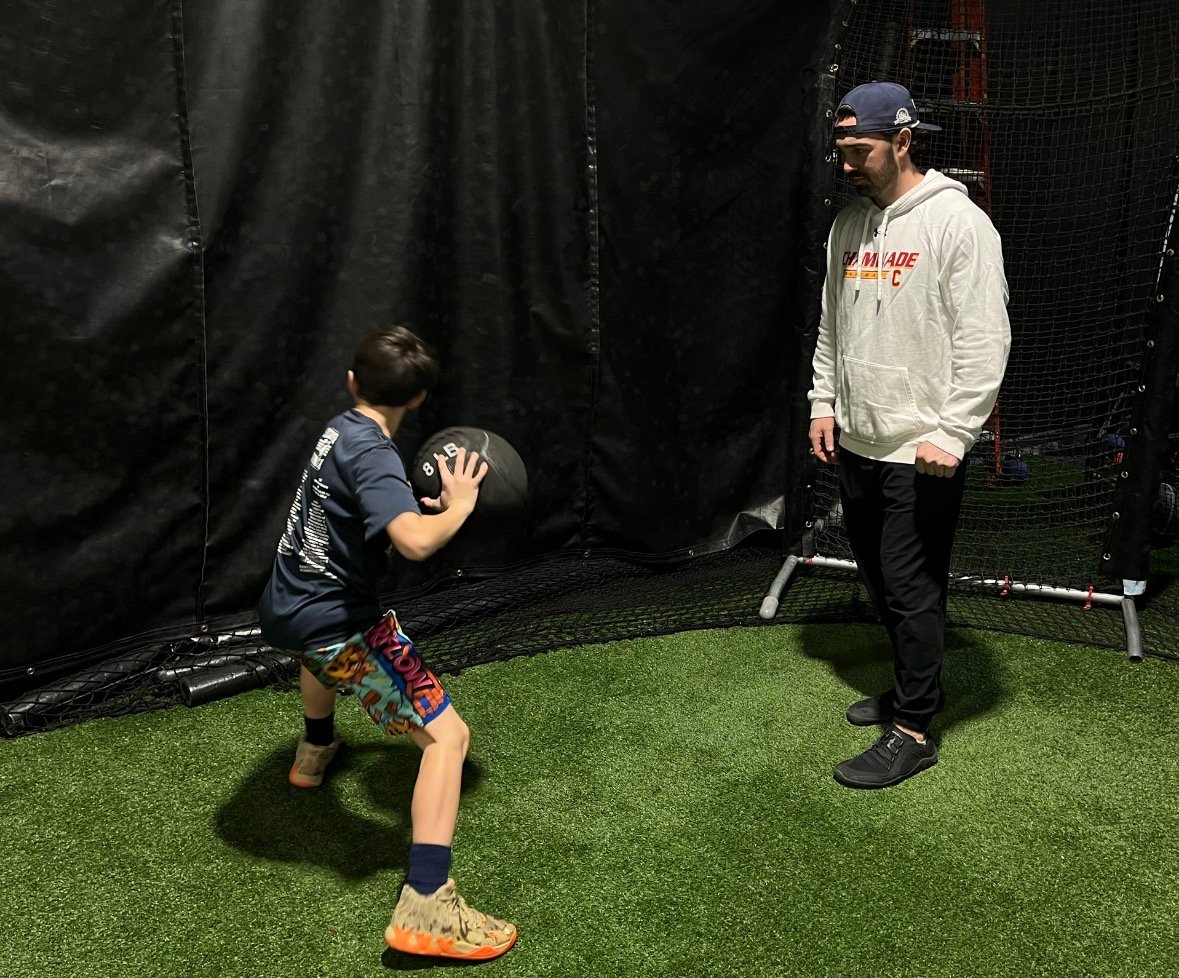
The training course is a month-long program that trains for five hours each week. The athletes will participate in two hours of biomechanic training, two hours of baseball training, and one hour of American Ninja Warrior training, where athletes will navigate obstacle courses that require dynamic movements they otherwise would never be doing. All of this with the end goal of permanently improving their athleticism.
There is a tryout for the program to ensure there will not be too large of a gap in abilities between participants, but it is solely based on athleticism, not any sport specific skills like hitting a baseball. The biomechanic portion of the training will see athletes complete a vast array of exercises like box jumps, ladder drills, lunges, and other motion focused exercises to train their bodies to move in many new and different ways.
We think it’s really important to move your body in ways its not used to, Madeline said. If you’re ever forced to roll or fall, something your body isnt used to doing, youre way more likely to get hurt if you dont know how to do it in a safe, correct way.
The baseball portion of the program is run by Madelines brother, Straton Podaras, who was a standout at Chaminade and later Radford college before being drafted by the Los Angeles Angels. It encompasses all aspects of the sport, with different coaches specializing in specific aspects of the game, like outfield coordinator Kraig Binick, who was drafted by the Orioles after a stellar career at NYIT, and later played for the Long Island Ducks. While hitting and fielding, the focus is still on moving as efficiently as possible.
But as Manning explained, Biomechanics in Motion does not want to only train baseball players. They aim to open up the program to all athletes, and offer training in as many sports as possible.
These professional grade coaches, combined with Madeline Podaras experience as both a researcher and personal trainer, offer a training environment with experts in both sports science and sport specific skills that would be difficult to find anywhere else. The Podaras siblings and Manning are confident that the training they offer at Biomechanics in Motion can be beneficial to athletes from any sport.
The cornerstones of the program and areas where athletes can expect improvement, as described by Madeline, are power and explosivity, strength, hand eye coordination, footwork, and speed and agility.
As Manning and the Podaras siblings seek to expand Biomechanics in Motion to include all sports, Madeline is also working on new programs to implement into the course that focus on preventing specific injuries. She explained their newest offering centered around ACL injury prevention.
For our latest offering at Biomechanics in Motion, weve partnered with Professional Athletic Performance Center to bring comprehensive motion capture analysis designed to identify athletic predispositions for ACL tears, Madeline told Axcess. Together, weve developed a 10 minute Dari motion capture protocol that objectively analyzes an athletes kinetic chains.
Using this data, we generate a report highlighting key areas for improvement that contribute to ACL tear risk and provide strategies using the principles of biomechanics to address these areas and reduce that risk.
After just two years of operation Biomechanics in Motion has grown quite a bit both in scale and scope, and will continue to do so as they welcome new athletes from all sports and introduce new, innovative and science backed ways to maximize athletes potential while setting them up for success and good health down the line.
To see for yourself what Biomechanics in Motion has to offer, visit their webpage at biomotionny.com